


Dozens of residents from Greater Kaohsiung’s Dalinpu (大林蒲) area staged a rally in front of the Environmental Protection Administration (EPA) yesterday, protesting the South Star Plan (南星計畫) development project, before the start of an environmental impact assessment (EIA) general assembly meeting in the afternoon.
The South Star Plan’s first phase development project, a 46.64 hectare area of reclaimed land in Greater Kaohsiung’s Siaogang District (小港) that has been targeted for development into a yachting industry park, was among the 14 cases to be discussed during the meeting.
“You will be overcome with sadness if you come and visit the area we live in,” a borough chief surnamed Huang (黃) told committee members and the project developer. “For so many years, the land has been filled with various types of foul industrial waste, including medical waste.”
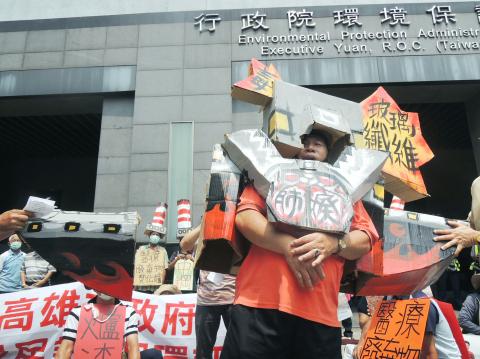
Photo: Liu Li-jen, Taipei Times
“If the project is approved, we will become like the filling in a sandwich biscuit, squeezed in a small area between several industrial areas, including state-run refiner CPC, Taiwan, state-owned integrated steelmaker China Steel, and state-owned Taiwan Power,” he said, adding that many local residents have already become sick from air pollution.
A local resident in her 60s, Chen Yu-hsi (陳玉西), said she was furious that the area that she has lived in for more than 60 years used to have a beautiful coastline and quality farmland, but is now occupied by high-polluting industries.
Moreover, the last stretch of coastline may become developed by the yachting industry, leaving them with “no more place to breathe fresh air,” Chen said.
A member of a local culture protection group said that although major development projects are always touted as creating job opportunities in rural areas, they have instead created industries where working conditions are often “highly polluted, very dangerous, with long working hours and low salaries,” so young people are still eager to leave the area to seek employment elsewhere.
Other concerns include sediment from the ocean near the landfill area that may be contaminated with heavy metal substances and the pollution that may be caused by the yachting industry.
The project failed to pass the review yesterday afternoon, with the assembly citing an incomplete evaluation of the risks involved.
Several other cases that were discussed during the meeting yesterday also faced protests and opposing opinions from local residents and civic groups.
Residents from Yunlin and Penghu expressed concern that Taiwan Power’s plans to build a submarine cable between Yunlin County and Penghu County might lead to overpumping of groundwater, which might destabilize the foundation of houses nearby. They were also concerned about the negative effects of long-term exposure to high levels of electromagnetic radiation.
Meanwhile, residents from Miaoli County’s Yuanli Township (苑裡) protested against wind turbines being erected too close to their homes, saying it could pose a health risk.
They said that the wind energy company included in the project did not communicate with local residents before beginning its construction work.
Civic environmentalist groups expressed concern about the environmental monitoring project at Changhua County’s Changpin Industrial Park (彰濱工業區), questioning why a few important items were not included, such as the soil, groundwater and the rare species of Chinese white dolphin off the coastline near the park.


UPGRADE: The Kang Ding-class frigate is replacing its Chaparall missiles with Tien Chien II and Hua Yang VLS, which would provide it with long-range, 360° air defense Taiwan plans to produce 1,200 to 1,376 Hai Chien II missiles (海劍二, Sea Sword II) — also known as TC-2N — to serve as the standard air defense system of the navy’s surface combatant fleet, a source said yesterday. Last week, the Hai Chien II, the naval version of the Tien Kung II missile (天劍二, Sky Sword II), completed a live-fire test in waters off the National Chungshan Institute of Science and Technology’s Jiupeng facility (九鵬) in Pingtung County’s Manjhou Township (滿州). The MIM72 Chaparral and other dated air defense missiles that currently arm Taiwanese ships have inadequate range to combat Chinese

REASONS FOR TRAVEL: An assistant professor said that proposed amendments to penalize drivers if they used drugs overseas would not deter people from traveling People who operate a motor vehicle under the influence of marijuana would have their driver’s license revoked, even if they used the substance while overseas, the Ministry of Transportation and Communications said yesterday, citing proposed amendments to the Road Traffic Management and Penalty Act (道路交通管理處罰條例). The amendments would also authorize the government to revoke the licenses of people determined to have used Category 1 or Category 2 narcotics, even if they were not operating a vehicle while under the influence of drugs, as well as ban them from taking the license test for three years, the ministry said. People aged 18 or
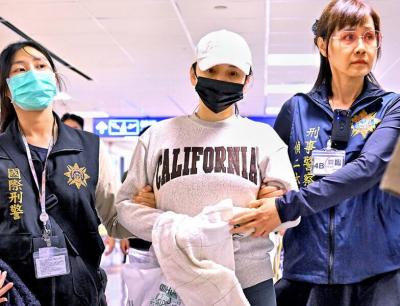
Johanne Liou (劉喬安), a Taiwanese woman who shot to unwanted fame during the Sunflower movement protests in 2014, returned to Taiwan last night after being deported from the US. She is to stand trial in Taiwan for charges involving embezzlement, fraud and drug crimes. The Criminal Investigation Bureau (CIB) said it took her into custody at Taiwan Taoyuan International Airport and would first question her before transferring her to the New Taipei District Prosecutors’ Office. She was arrested upon disembarking a flight from San Francisco that landed shortly before 7pm. Liou absconded to the US in 2019 after jumping bail

Shih Hsin University President Chen Ching-he (陳清河) yesterday issued a public apology for comments made in his commencement speech last week, stating that he has asked the school to suspend his duties and halt his wages for two months as a show of contrition. At the commencement ceremony on May 30, Chen said, “If you don’t manage your time well, or your own emotions, or your health, then I am telling every one of you — put a quick end to ‘you,’ because the world has no need for ‘you.’” The comments have sparked significant controversy online, and Chen through an open


 RSS
RSS